


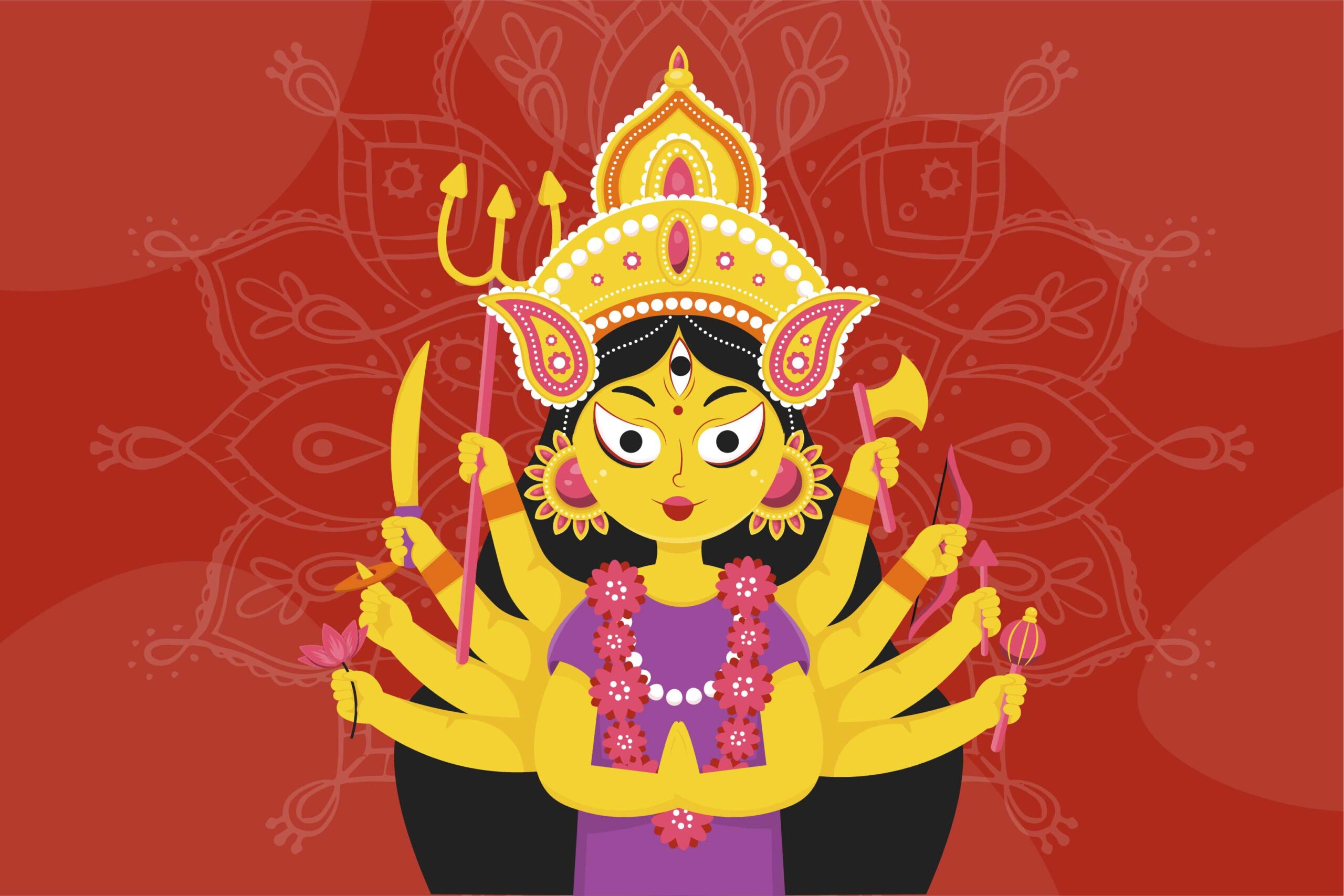
Navaratri or Dashain is a celebration of the feminine dimensions of existence. Across these nine days, the traditions of Durga, Lakshmi and Saraswati offer us a profound way of understanding life itself: its roots, its activity and its possibility of transcendence. These three dimensions are also reflected in the three fundamental qualities of existence: tamas, rajas and sattva.
Tamas is inertia, stillness and the quality of the Earth from which life arises. Rajas is movement, activity and passion, represented by the dynamism of the Sun. Sattva is the possibility of dissolving limitations, represented by the Moon and its association with awareness, knowledge and transcendence.
The first three days of Navaratri are traditionally dedicated to Durga or Kali, the next three to Lakshmi, and the final three to Saraswati. This sequence has a certain intelligence. First, there is the Earth. From stillness, life takes form. Then comes activity. Once life has taken form, it begins to move, desire, create and engage with the world. But beyond activity lies another possibility: to go beyond the limitations of the physical and experience something deeper. The first two are fundamental to survival. The third is an aspiration. Yet Navaratri is not only about what we worship. It is also about how we approach life.
There is a tendency among human beings to become serious about everything they consider important. If something does not appear important, they become careless about it. Neither extreme allows us to experience life fully. The stronger possibility is to be absolutely involved without being burdened by seriousness. This is why so many profound aspects of Indian culture are expressed through celebration. Music, dance, ritual, colour and community are not merely entertainment. They can become ways of participating in life with total involvement. A flower does not need to announce that it is blooming. It simply blooms. Yet we often do not have the attention to watch it happen. We can spend an hour looking at a screen, but sitting quietly and watching a flower open can seem like a waste of time. This tells us something about the way we live.
If we cannot pay attention to the smallest details of existence, how can we expect to experience its deepest dimensions?
Spirituality is not necessarily somewhere far away. It is in the breath, the body, the earth beneath us, the people around us and the ordinary moments we are too distracted to notice. The earth itself is a remarkable reminder. What we casually call soil or dirt can become a magnificent flower. That same earth has become our body. We are not separate from it. We arise from the Earth, live through its resources, and eventually return to it. What begins as stillness becomes a living, dynamic human being. Navaratri asks us to recognise this movement within ourselves. But Dussehra brings another dimension to this understanding.
The story of Rama and Ravana is often reduced to a simple opposition between good and evil. Rama represents righteousness; Ravana represents wrongdoing. The destruction of Ravana becomes the symbolic victory of good over evil. But there is a subtle wisdom within the story. Ravana is traditionally depicted with ten heads. These can be understood as representing the many tendencies that can exist within a human being: greed, jealousy, lust, anger, pride and other destructive qualities. Yet Ravana was not devoid of wisdom. He was also a great scholar, a powerful being and a devoted worshipper of Shiva. His terrible actions did not erase every other dimension of his existence.
The profound lesson is not that we should overlook wrongdoing. It is that we should learn to distinguish between a person’s actions and the entirety of the person.
When someone behaves badly, we are quick to condemn the whole individual. We take one quality, one action or one moment and turn it into an identity. But every human being contains contradictions. There may be anger in one moment and compassion in another. There may be jealousy, but there may also be generosity. There may be ignorance, but there may also be tremendous intelligence. There may be cruelty alongside tenderness.
The question is: What do we choose to see?
This does not mean becoming blind to wrongdoing. We must recognise the thorn if there is a thorn. We must act when something is harmful. But recognising the thorn does not require us to deny the flower. This distinction is essential. When we condemn a quality, there remains a possibility for change. When we condemn the entire person, we leave no room for transformation. And there is another reason this matters. What we repeatedly see in others begins to shape our own inner world. If you spend your life looking only for greed, dishonesty, ugliness and cruelty in people, those are the qualities you will become increasingly familiar with within yourself. If you learn to recognise beauty, generosity and compassion even in imperfect people, those qualities become more available within you. The same principle can be applied to ourselves. We often reduce ourselves to our failures, our mistakes and our limitations. But human beings are not finished products. There is always the possibility of another dimension.
Sadhguru
If we cannot pay attention to the smallest details of existence, how can we expect to experience its deepest dimensions?
This is where the symbolism of Navaratri becomes especially powerful. From tamas comes rajas. From activity comes the possibility of sattva. From identification with the physical comes the possibility of transcendence. Life is constantly moving between states of stillness and activity. This happens within an individual and, on a much larger scale, throughout nature and the cosmos. But human beings have the capacity to become conscious of this movement. Perhaps this is why celebration has always been so central to these festivals. Celebration allows us to participate in life without trying to control every moment of it. It allows us to be involved without becoming psychologically trapped in what happens. So, as Navaratri begins and Dussehra approaches, perhaps the most meaningful celebration is not simply the burning of an effigy or the completion of a ritual. It is to look at our own ten heads. To recognise the greed, jealousy, anger and fear that may arise within us, without concluding that these are all that we are. And then to look at another human being in the same way. See the mistake. See the limitation. See the thorn. But also look for the one beautiful head. The head of love. The head of wisdom. The head of generosity. The head of compassion. The head that still holds the possibility of becoming something more. This is not weakness. It is a more complete way of seeing.
Navaratri reminds us of the possibility of moving from inertia to activity and from activity towards transcendence. Dussehra reminds us that even when darkness is present, we must not become incapable of recognising what is luminous.
The two festivals, together, offer a powerful invitation: be fully involved in life, but do not become imprisoned by it. See clearly, but do not become cynical. Recognise what is wrong, but do not lose your ability to see what is beautiful. Perhaps that is the real victory over Ravana, not merely destroying what is outside us, but refusing to allow the destructive qualities within us to become our identity.
Sadhguru
If you learn to recognise beauty, generosity and compassion even in imperfect people, those qualities become more available within you.
Ranked amongst the fifty most influential people in India, Sadhguru is a Yogi, mystic, visionary and a New York Times bestselling author. Sadhguru has been conferred the Padma Vibhushan by the Government of India in 2017, the highest annual civilian award, accorded for exceptional and distinguished service.