

Marriage Compatibility in Hindu Astrology
By Medina Joshi, Astro & Vaastu Consultant
Foundations of Compatibility
Classical Jyotisha places great emphasis on ensuring harmony across the mental, emotional, and biological dimensions in a marriage. It seeks to safeguard the longevity of the union while identifying and avoiding doshas that could lead to separation, loss, or conflict. Additionally, it highlights the importance of fostering prosperity, ensuring progeny, and maintaining peace and well-being within the household, making compatibility a holistic measure of marital success.
Ashtakoot Milan (Eight-Fold Compatibility Test)
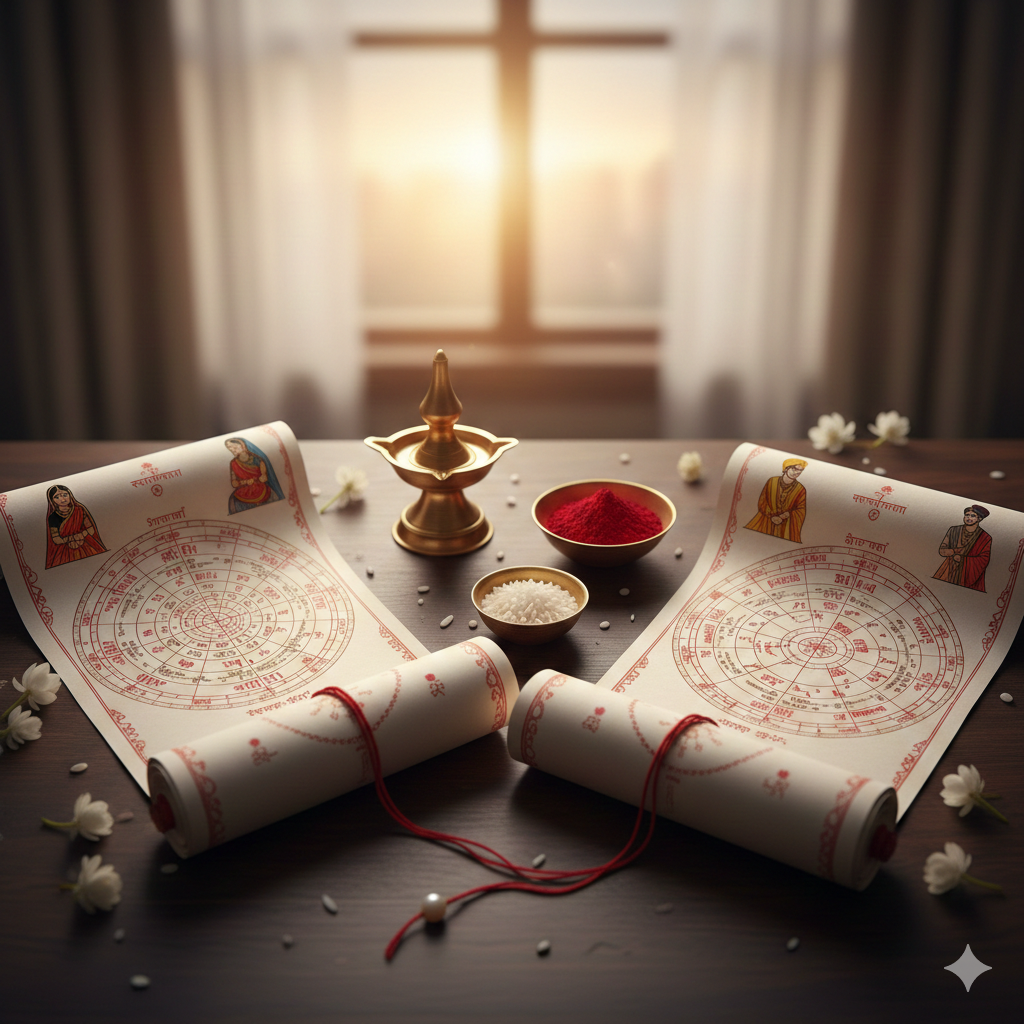
The word Ashta means “eight” and Koot means “category.” Thus, Ashtakoot Milan is an eight-fold compatibility test. Each person is born under a particular nakshatra (lunar constellation), which falls into different division under each kootas under consideration. By crossmatching the bride’s and groom’s each kootas, astrologers assess harmony across spiritual, emotional, physical, and genetic dimensions.
The Ashtakoot system awards up to 36 points (guna). Traditionally, 18+ is acceptable, 24+ good, 28–32 excellent. Below 16–18 is discouraged.
• Muhurta Chintamani emphasizes Tara, Bhakoot, and Nadi as most decisive.
• If Gana, Bhakoot, or Nadi score 0, marriage is generally prohibited even if total points are high.
Major Doshas Beyond Ashtakoot
Even with high guna scores, certain defects must be avoided:
• Manglik (Kuja) Dosha: Mars present in 1,4, 7, 8, 12 house (2 house in southern part of India) of the birth chart. However, it is considered neutralized if both bride and groom are Manglik.
• Rajju Dosha: Same Rajju nakshatra – severe marital danger (poverty, accidents, loss of children).
• Vedha Dosha: Certain nakshatra pairs afflict each other (e.g., Ashwini–Jyeshtha).
• Dwadashashtaka / Ashtama Rashi Dosha: Moon signs in 6/8 or 8th relation – health and financial issues.
Navamsa (D9) Chart Analysis
The Navamsa (D9) chart is a crucial tool in evaluating marital prospects, as it reveals the deeper nature and dynamics of a relationship. In this chart, the strength of Venus for males and Jupiter for females plays a vital role in determining compatibility and marital happiness. Afflictions to the 7th lord in the D9 chart are considered more serious than similar afflictions in the D1 chart, indicating potential challenges in married life. Conversely, benefic influences in the D9 chart significantly enhance marital harmony and the overall quality of the relationship.
Longevity & Progeny Considerations
• Ayushya checks: Avoid mismatched life expectancy yogas.
• Progeny factors: 5th house, Jupiter, Putrakaraka, Nadi, and Saptamsa (D7 chart).
• Classical texts warn that Nadi Dosha directly affects progeny and health.
Remedies and Exceptions (Parihara)
• Nadi Dosha: Nadi Nivaran Puja, Mahamrityunjaya Japa, or exceptions (different nakshatra padas’ combination nullifies this dosha).
• Bhakoot Dosha: Graha Shanti Puja, Nava Graha Puja or special homa.
• Manglik Dosha: Kumbha Vivaha, Mangal Chandika Puja. (Both bride and groom are Mangalik, then Mangalik Dosha is self-nullified)
• Rajju Dosha: No effective remedy; marriage usually avoided.
These remedies have logical reasoning behind it. For an instance, in classical Hindu astrology, Ghata Vivaha and Kumbha Vivaha are regarded as the most effective and spiritually significant solutions prescribed to neutralize the harmful effects of Mangal Dosha (Kuja Dosha). The reasoning behind these remedies is deeply rooted in ancient belief systems and symbolic representations.
For a woman affected by Mangal Dosha, Ghata Vivaha, the ritual marriage to a sacred pot (ghata) is considered highly auspicious. In this ceremony, the pot is symbolically regarded as an incarnation of Lord Vishnu. According to tradition, when a woman marries Vishnu in this symbolic form, she becomes blessed with Akhanda Saubhagya, meaning eternal marital fortune and protection. Such a woman is believed to remain safeguarded from untimely death or severe health issues. Moreover, this ritual is said to dissolve inauspicious yogas in her horoscope. Conditions such as avivah (delay in marriage) or repeated obstacles causing failed alliances are believed to end after the ceremony. Thus, the ritual clears karmic hurdles and prepares her for a harmonious marital life.
Similarly, if a man performs Ghata Vivaha, the symbolic marriage is considered to be with Goddess Lakshmi herself. Lakshmi is the embodiment of prosperity, well-being, and unbroken marital fortune. Because of this divine association, the man becomes shielded from negative karmic influences that could harm his marriage. Classical belief holds that his future wife is protected from disease and unnatural death. In this way, the ritual serves as a powerful spiritual safeguard, ensuring stability, longevity, and harmony in his marital life.
” Many exceptions, cancellations, and special conditions within both charts can neutralize certain doshas. Therefore, a complete evaluation of all rules, exceptions, and recommended remedies is necessary before reaching any final judgment.”
Medina Joshi
Final Judgement
The final assessment of marital compatibility should be approached holistically, taking multiple factors into account. These include the Ashtakoot score, analysis of doshas such as Manglik, Nadi, Bhakoot, and Rajju, and evaluation of the Navamsa chart. The strength of the 7th house, Venus, and Jupiter is also critical, along with considerations related to progeny and longevity. In addition, practical aspects such as education, family background and personal habits must be included to ensure a comprehensive and balanced judgement.
Classical Instruction (Muhurta Chintamani):
“Do not rely on kootas alone, inspect planets, houses, and nakshatras holistically. “
Hindu astrology regards marriage as a sacred karmic bond. The Ashtakoot Milan system, when combined with comprehensive chart analysis, helps ensure that couples enter married life with harmony, prosperity, and healthy progeny. A high guna score by itself is insufficient; the absence of major doshas and the strength of key houses are essential and must never be overlooked.
Moreover, many exceptions, cancellations, and special conditions within both charts can neutralize certain doshas. Therefore, a complete evaluation of all rules, exceptions, and recommended remedies is necessary before reaching any final judgment. Because of this complexity, consulting a qualified and experienced astrologer is strongly advised for accurate and dependable guidance.
Ultimately, compatibility assessment in Hindu astrology goes beyond ritual, it serves as a divine safeguard for marital well-being. Through careful horoscope analysis, astrologers help ensure that couples begin their union with balance, health, and prosperity, honouring the sacred purpose of marriage.
References
• Narayan Daivagya, Muhurta Martanda (with the commentary Martanda Vallabha, edited by Satyendra Mishra, 1997 A.D.), Varanasi, Chaukhamba Krishnadas Academy.
• Ram Daivagya, Muhurta Chintamani (with the commentary Piyushdhara, commentator: Pawandeshwori Prasad Dwivedi, 2022 A.D.), Varanasi, Chaukhamba Surbharati Prakashan.
• Parasara, Maharshi. Brihat Parasara Hora Sastra. Interpreted by Dr. Sureshchandra Mishra, 2025 A.D. New Delhi: Ranjan Publications.
• Mantreshwor, Phaldeepika (Bhavartha Bodhini), Translated by Gopesh Kumar and Ashutosh Ojha 2014 A.D., Varanasi: Chaukhamba Publishers.