


In a time when our lives are filled with noise, speed and constant stimulation, there are rare moments when we are invited to pause, to sit with ourselves, to listen and to feel. It is within this sacred pause that artist Sangee Shrestha situates her exhibition Antardrishti, a body of work that is less about being seen and more about being felt.
For Sangee Shrestha, art begins where language dissolves. Her practice is rooted in a profound belief that making art is a sacred dialogue; one that connects the visible and invisible, the human and the divine. Her work becomes both a mirror and a refuge, reflecting the inner self while offering stillness in a chaotic world.
One of the most compelling aspects of Antardrishti is its exploration of duality. Shrestha moves fluidly between painting and ceramics, gesture and structure, energy and matter. Her paintings often feature layered surfaces and geometric forms, hinting at contemporary life and the fragmentation of modern identity. In contrast, her ceramic works carry the weight of touch and of time. Together, these media interplay, and her artistic language finds its strength.
A striking shift in this body of work is her use of darker, muted tones. At first glance, these colours may seem subdued, even sombre. But linger a little longer and they reveal inwardness. They invite the viewer to slow down, to look beyond surface beauty and into the layers beneath. Light does not shout here but glows softly, revealing texture, shadow and emotional depth. In embracing restraint, Shrestha creates space for contemplation, a space to gently hold and embrace the viewers instead of overwhelming them.
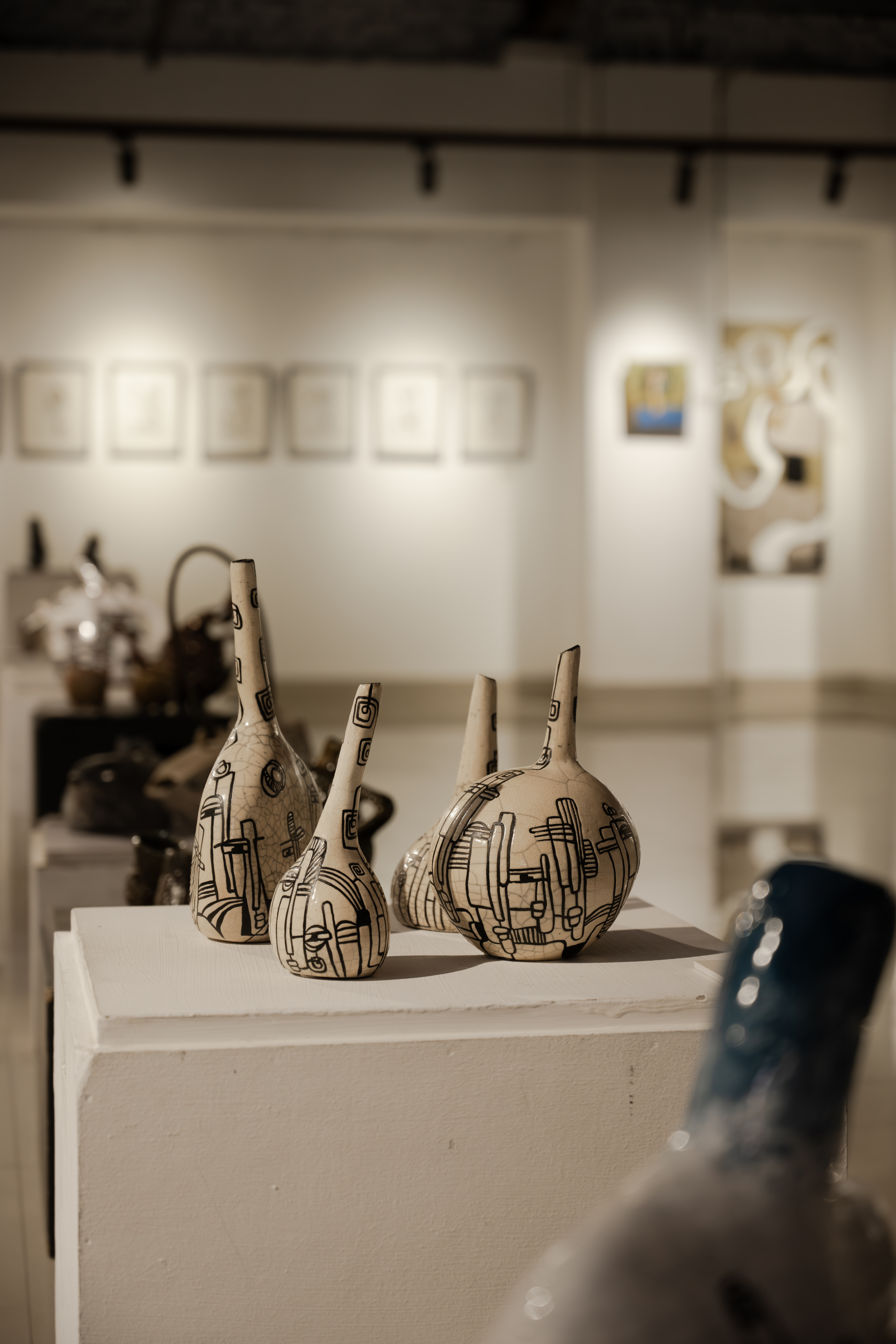
Antardrishti
Antardrishti is the result of almost two years of hard work and deep self-reflection. Sangee Shrestha allows her powerful, feminine self to shine through in this series of intense works, showing us this artist’s range and her ability to transform her ideas into tangible, indelible artworks. One of the great Nepali artists working today, all the more remarkable for a woman in a man’s world, Sangee Shrestha’s Antardristi is an exceptional showcase of her power as an artist.
Rooted in Nepal, Speaking to the World
Growing up in Nepal, where ritual, symbolism and spirituality are woven into everyday life, Shrestha developed an early understanding of the sacredness of creation. From temples and ancestral traditions to handcrafted objects, meaning has always extended beyond the material. This cultural grounding is deeply embedded in her work. Her female figures, often depicted with one eye gently open, emerge as embodiments of a modern Shakti, aware, resilient and deeply connected to inner truth.
Words from the Artist
What was the emotional or spiritual starting point for Antardrishti?
The emotional and spiritual beginning of ‘Antardrishti’ came from a time of deep reflection. The noise of the outside world felt overwhelming and I felt a strong need to slow down and turn inward. In that quiet space, I realised that true seeing is not only through the physical eyes, but through inner awareness.’ Antardrishti’, meaning “inner vision,” grew naturally from this understanding. Through ‘Antardrishti’, I explore how self-awareness can lead to healing, balance, and a deeper connection with ourselves and the world around us.
How do you decide which medium a particular emotion or idea belongs to? What does this process mirror in your own inner journey?
I don’t choose the medium only with logic; I listen to the emotion behind the idea. Some emotions feel light and flowing, and they naturally become paintings, where colour and movement can express them freely. Other emotions feel heavy and grounded, and those go into clay, where touch and texture become important. This process reflects my own inner journey. Just as each emotion needs a different medium, each inner experience needs a different kind of care. Moving between painting and ceramics is my way of respecting those changing inner feelings
The single open eye in many of your figures has become a signature. Has its meaning evolved for you over time?
The single open eye began as a symbol of inner awareness. It is the way to suggest that seeing is not only through the physical eye, but through consciousness itself. Over time, its meaning has deepened. It has come to represent not just perception, but presence, clarity, and the courage to face both light and shadow within ourselves. For me, it is also a mirror. I also feel it is an invitation to the viewer to awaken their own inner sight to pause and look beyond the surface. The eye continues to evolve in my practice, carrying both personal reflection and a shared call for mindful connection.
Your work often channels feminine energy and a sense of modern Shakti. What does feminine strength mean to you today?
To me, feminine strength today is both quiet and powerful. It is resilience without aggression, intuition paired with action, and compassion that does not compromise clarity. It is the courage to hold space for oneself and others, and also for the unseen forces that guide us.
The Artist: Sangee Shrestha
“My works do not speak over the viewer; they speak with them. They are not conclusions, but open spaces for quiet observation and inner dialogue.” – Sangee
A multidisciplinary freelance visual artist whose professional journey spans over three decades. She holds a Bachelor of Fine Arts from the Fine Art College and a Master’s degree in History, Culture, and Archaeology from Tribhuvan University. Her multidisciplinary work explores the complexities of human emotion, identity, and social contradiction through a distinctive blend of figurative expression and geometric abstraction. Her signature style critiques human hypocrisy and explores emotional states such as love, hate, joy, and jealousy. Her use of geometric shapes, particularly the rectangles, squares, and polygons, disrupts the surface to evoke deeper psychological and social dimensions, suggesting the fragmentation and mechanisation of contemporary life. She has been awarded the National Award in Contemporary Art (2018), Special Award by the National Academy of Fine Arts (2015), Araniko National Art Award: Gold Medal (2010), and the Best Painting Award from the Camlin Art Foundation, India (2007), among others.
She has also served as an illustrator, cartoonist, educator, and art writer. She has led several cultural and community research projects as a team leader for Kathmandu Metropolitan City (KMC), contributing to the documentation, preservation and promotion of Kathmandu’s diverse cultural heritage. She is Vice President and a founding member of Women Artist Group of Nepal (WAGON), and also a founding member of Lalitkala Literature Society and Nepal Art Critics Society.